
Stop 'Speaking to Users' — Why You Need Desperate People Who Speak to You First

Thomas McDonough
Product & Engineering
6 min read
February 11, 2026
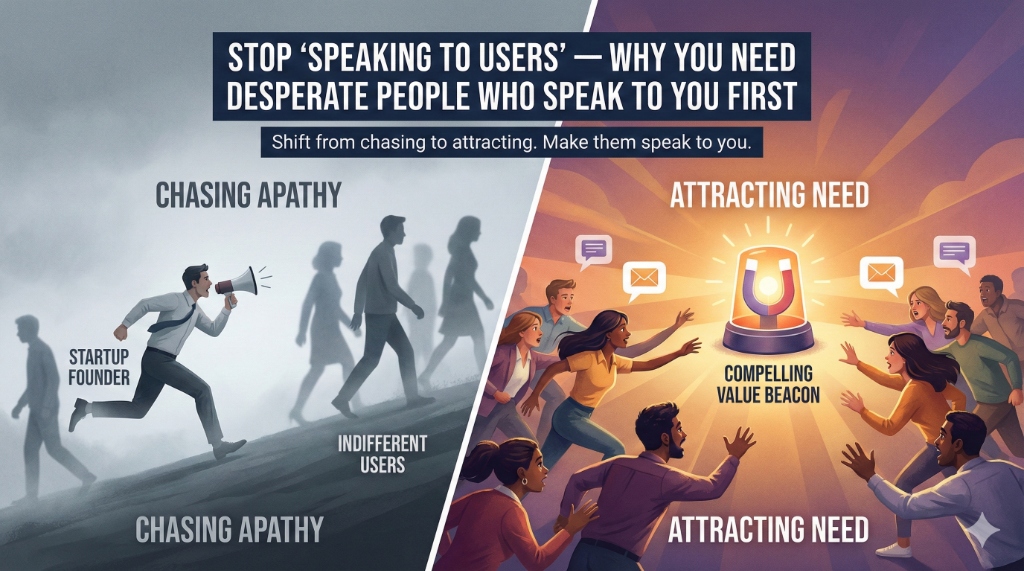
We've all heard the advice. It's the first commandment of the startup bible, preached by everyone from Eric Reis to Y Combinator: "Speak to users."
Get out of the building. Do customer interviews. Ask open-ended questions.
But here is the uncomfortable truth: This advice is often wrong.
Or more accurately, it's incomplete. It puts the cart before the horse. If you have to chase users down to extract feedback, you have already lost. You are fighting an uphill battle against apathy.
The real goal isn't just to speak to users. It's to build something so compelling that users speak to you first.
The Problem with "Speaking to Users"
When you initiate the conversation, you introduce bias. You are asking for a favor. A user who agrees to an interview is often just being polite. They will tell you what you want to hear. "Sure, I'd use that." "That sounds interesting."
Polite feedback is the death of a startup. It gives you a false signal of product-market fit.
What you need isn't polite interest. You need desperation.
You need users who are in so much pain, or who have such a burning desire for a solution, that they are hunting you down. They aren't doing you a favor; they are hoping you can save them.
Strategy Before Conversation: How to make them speak to you
Before you book a single user interview, you need a strategy to identify these desperate people. You need a mechanism that acts as a beacon.
We've seen our customers use "Attraction Strategies" to validate their ideas without pitching a single person.
1. The "Trojan Horse" Utility
One of our customers, a cybersecurity founder, was struggling to get time with CISOs. Cold emails were being ignored. LinkedIn messages were marked as spam.
Instead of asking for a meeting, they built a simple, free open-source script that scanned for a specific, trending vulnerability. They posted it on GitHub and Reddit.
Within 48 hours, CISOs were running the script. When the script found a vulnerability, the output simply said: "Vulnerability Detected. Contact [Founder] for the remediation patch."
The result? The CISOs emailed him. They were scared, they needed a fix, and they were ready to pay. He didn't have to sell the problem; the free utility did it for him.
2. The "Internal Tool" Strategy
Another customer was building an enterprise workflow tool for legal teams. It started as a messy internal script they used to organize their own consulting work.
They assumed they needed to "polish" it before showing it to anyone.
Growthmind advised the opposite. We told them to release a "leaked" internal memo detailing exactly how their chaotic script saved them 20 hours a week.
They shared the memo in a legal tech community. It wasn't a pitch; it was a confession of how they were "cheating" to get work done faster.
Partners at major firms started DMing them: "Can I get a copy of this script? I don't care if it's ugly. I need to save time now."
They validated the desperate need for efficiency before they wrote a single line of production code.
Our Turn: The "Reverse Launch"
We didn't just advise this; we lived it. At Growthmind, we decided to put our own problem through our own AI engine. We asked Growthmind how to grow Growthmind.
The AI suggested a counter-intuitive growth hack: The Reverse Launch.
Instead of launching our own product and begging for attention, it told us to launch other people's products. We should offer to do this for free.
It sounded crazy. Why would we spend our time promoting other startups? But we tried it. We put out the offer. And something shifted.
Suddenly, we didn't have to chase anyone.
Founders—desperate to get traction, terrified of launching into the void—started messaging me. They weren't family members being supportive. They weren't friends being nice.
They were strangers. They were stressed. They were ambitious. They were looking for an edge.
These were the seemingly "right" users, but more importantly, their behavior validated the problem far better than any interview could.
- They initiated contact. (High intent)
- They had a specific, urgent problem. (Launch anxiety/need for growth)
- They were willing to trust a stranger. (Desperation)
This wasn't a "nice to have" conversation. This was a "please help me" conversation.
Stop Chasing, Start Attracting
If you are currently struggling to get users to talk to you, stop trying to force it.
The step before "speaking to users" is identifying a strategy that compels them to reveal themselves.
Find the hair-on-fire problem. Create a value-first offer—like our Reverse Launch—that directly addresses that pain. Put it out there.
If silence follows, you don't need better interview questions. You need a better problem to solve.
But if people start sliding into your DMs, emailing you out of the blue, and asking "When can I use this?", then you know you're onto something.
Don't just speak to users. Make them speak to you.
Thomas McDonough
Product & Engineering at Growthmind
Ready to stop guessing?
Get your free assessment and run your first focused experiment this week.
Start Free Trial