
Why Progressive Interrogation UX will be the End of Chat-Based UX in AI Apps

Thomas McDonough
Product & Engineering
8 min read
January 20, 2026
Every product manager in AI knows the rule: reduce friction. Make onboarding seamless. Drop them into the chat interface as fast as possible.
I believed this completely. Until I realized it was killing our product.
At Growthmind, we’re building an autonomous growth system for early-stage founders—people who are technical, busy, and often "reluctant marketers."
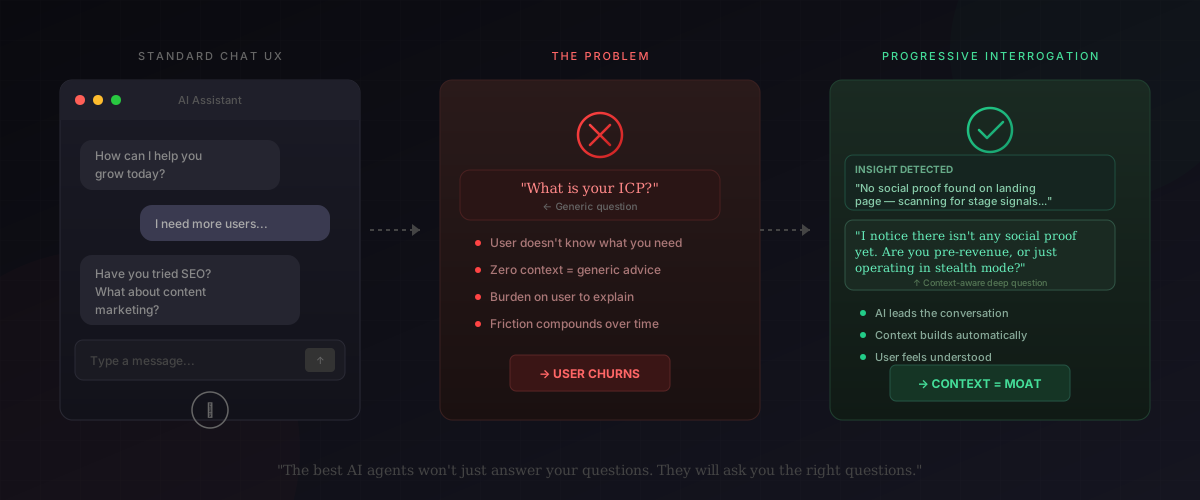
Our initial version was a standard chat interface. You’d sign up, and a helpful AI would ask: "How can I help you grow today?"
Do you know what happened? Paralysis.
Founders stared at the blinking cursor. Or they typed generic things like "I need more users." And naturally, our AI gave them generic advice: "Have you tried SEO? What about content marketing?"
It was frictionless. And it was useless.
We realized that for complex, high-stakes domains like company strategy, Chat UX is a trap. It puts the burden of context-setting entirely on the user.
So we flipped the script. We built what I call Progressive Interrogation UX. And it changed everything.
The Blank Slate Problem
The fundamental flaw of Chat UX is that it assumes the user knows what information the AI needs to be helpful.
In reality, users don't know what they don't know. A pre-seed founder doesn't know that their lack of a "Proprietary Insight" is why their cold emails are failing. They just know they aren't getting replies.
If you put them in a chat, they ask: "Write me a better cold email." The AI writes a grammatically perfect, strategically empty email. The user churns.
Enter Progressive Interrogation
Progressive Interrogation is a UX pattern where the AI takes the lead. It doesn't wait for a prompt; it actively hunts for the context it needs to generate a high-quality outcome.
It works like a senior consultant, not a subservient chatbot.
How We Implemented It at Growthmind
We completely redesigned our onboarding flow. instead of a form or a chatbox, we built a streaming active analysis.
As soon as a founder enters their URL, our agents start scanning their digital footprint—website, social profiles, competitor overlap. But instead of just spitting out a report, the AI interrogates the user based on what it finds.
Here is the moment that proved the thesis:
The "Zero Social Proof" Checkpoint In our old flow, we asked users: "What is your current traction?" Users hated answering it (especially if the answer was "zero").
In the new flow, the AI scans the landing page. If it finds no testimonials, no client logos, and no case studies, it pauses the analysis and asks detailed, specific questions:
"I notice there isn't any social proof on your landing page yet. Are you currently pre-revenue, or just operating in stealth mode?"
If the user selects Pre-revenue, the AI immediately pivots its entire strategy engine. It stops trying to find "Growth Channels" (which are useless for them) and starts a "Customer Discovery" interrogation:
"Got it. Since we're at 0 to 1, let's focus on the problem. I found 47 Reddit threads discussing the problem you imply on your homepage. Is this accurate to the pain point you are solving?"
The reaction from users was transformative.
They didn't feel "interrogated" in a bad way. They felt understood. They felt that the AI was "smart enough" to know they were early-stage without them having to type out a paragraph explaining their life story.
The Compound Friction Law
You might think adding questions adds friction. And technically, it does. But it introduces what I call the Compound Friction Law:
Upfront Interrogation reduces long-term friction exponentially.
By spending 3 minutes answering high-context questions during onboarding, the usage for the next 90 days becomes frictionless.
- Without Interrogation: Every time the user asks for a strategy, they have to remind the AI "Remember, I'm a solo founder, I can't do sales calls all day."
- With Interrogation: The AI knows. It never suggests a "Sales-led motion" because it established in Minute 1 that you are a solo technical founder who hates sales.
The Unbreachable Moat: Context
This is where the business case becomes undeniable.
Everyone is worried about GPT-6, Gemini-4, or Claude-5 making their app obsolete. But raw intelligence is a commodity; context is the moat.
A generalized "Super AI" might be smarter than Growthmind's current model. But if that Super AI doesn't know your specific constraints, your unique competitive angle, and the 15 subtle decisions you made last week... it cannot help you.
Progressive Interrogation builds a Context Graph of the user that gets richer with every interaction.
At Growthmind, once a user has been "interrogated" for a week, switching to a competitor feels like madness. "You mean I have to explain to this new AI all over again that my customers are technical developers who hate emojis?"
The End of Chat
Chat-based UX had its moment. It was the "command line" of the AI era—powerful, but demanding.
For complex, professional applications, the future is agentic, proactive, and interrogative.
The best AI agents won't just answer your questions. They will ask you the right questions, at the right time, to extract the genius that you didn't even know you had.
At Growthmind, we stopped asking "How can I help?" and started asking "Is this really your strategy?"
And our users have never been happier.
Thomas McDonough
Product & Engineering at Growthmind
Ready to stop guessing?
Get your free assessment and run your first focused experiment this week.
Start Free Trial